The Monthly Cost of Renting in Orlando, Line by Line
A line-by-line monthly budget for renting in south-west Orlando, built from published tariffs rather than estimates. Covers electricity, water and sewer, the toll spend most guides ignore, transit fares, and the Florida statutes on deposits and rent control. Checked 13 October 2026.
A commuter leaving Dr Phillips who crosses two Central Florida Expressway Authority main plazas in each direction pays $88.20 a month in tolls with a discounted E-PASS, and $235.20 for the same journeys on Pay By Plate — a gap of $1,764 a year created by nothing but a payment method. Here is what a month in south-west Orlando costs, line by line, with every figure taken from the utility, agency or statute that issues it.
The rent line, checked 13 October 2026
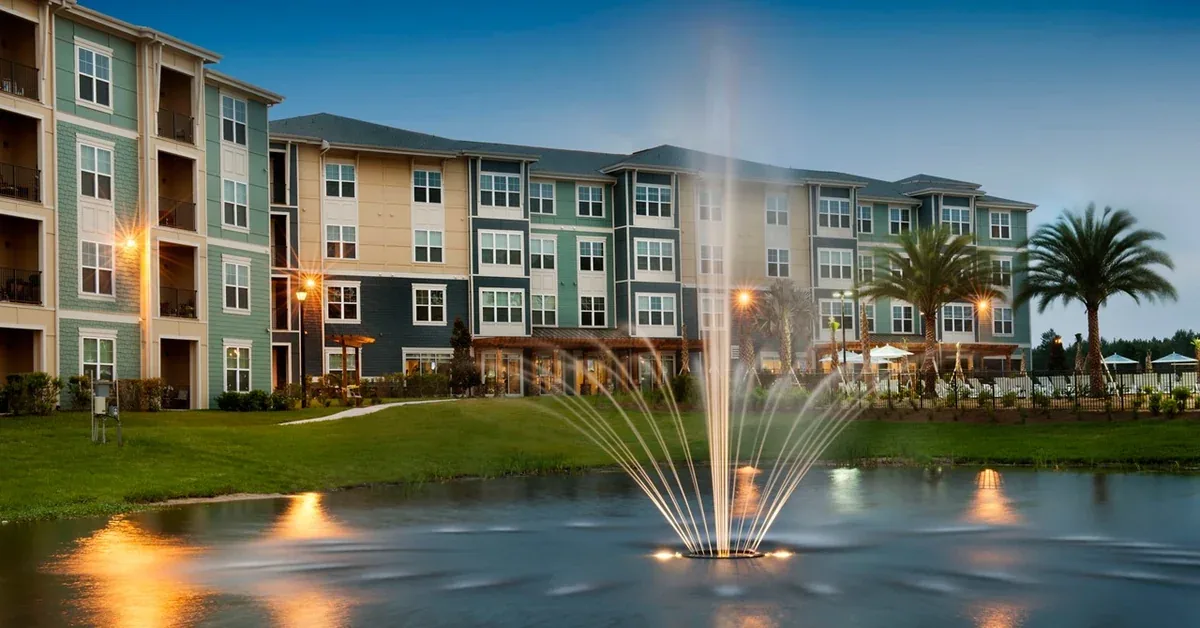
Citi Lakes, at 12024 Meadow Bend Loop, showed 36 available homes across 11 published floor plans on 13 October 2026. Price per square foot moves opposite to headline rent.
One-bedroom homes. Ten were listed, $1,508 to $1,752, at 749 to 859 square feet — $1.78 to $2.21 per square foot, the highest per-foot range here.
Two-bedroom homes. Twenty-one were listed, $1,812 to $2,034, at 942 to 1,132 square feet, or $1.71 to $1.96 per square foot — 58 per cent of everything available.
Three-bedroom homes. Five were listed, $2,248 to $2,338, at 1,258 to 1,322 square feet, or $1.70 to $1.81 per square foot — the lowest per-foot cost available. Availability changes frequently. The full floor plan line-up and the two-bedroom homes specifically are covered separately.
Electricity: find out who bills you before you budget
Orlando has two large electric utilities with different tariffs, and the boundary follows neither the city limits nor the postcode.
What the map shows. The Orlando Utilities Commission publishes its own service area map, revised October 2013 and still the current version on its site. Its electric territory covers 419 square miles and its water territory about 200, in different shapes. On that map the shaded electric area runs down the International Drive corridor to roughly the State Road 528 line, and the blocks around SeaWorld and Central Florida Parkway read as unshaded. Dr Phillips is unincorporated Orange County, much of which Duke Energy Florida serves. But the map is thirteen years old and resolves to neighbourhood rather than parcel level, so treat that as a direction of travel, not an answer. Check the street address on either utility's start-service page.
What OUC charges. On OUC's residential schedule, effective 1 October 2025, the monthly customer charge is $18.50, the non-fuel base charge 7.351 cents per kilowatt hour and the fuel charge 4.767 cents, for a total energy charge of 12.118 cents. At 1,000 kilowatt hours that is $139.68.
What Duke Energy Florida charges. On Duke's filed Rate Schedule RS-1, effective 1 October 2026, the customer charge is $14.43. Non-fuel energy from March through November is 7.731 cents per kilowatt hour for the first 1,000 and 8.503 above; December through February it rises to 8.805 and 10.302. Fuel sits on Rate Schedule BA-1 at 4.127 cents below 1,000 kilowatt hours and 5.197 above, and BA-1 adds five residential cost recovery clauses — conservation 0.386, capacity 0.133, environmental 0.040, asset securitization 0.238 and storm protection 0.936 — totalling 1.733 cents. At 1,000 kilowatt hours in a March-to-November month, that is $150.34.
The thing to notice. The lower customer charge is not the cheaper bill. Duke's fixed charge is $4.07 below OUC's, but once the separately filed clauses are added the Duke figure lands about $10.66 a month above OUC at 1,000 kilowatt hours — roughly $128 a year. Compare the all-in cents per kilowatt hour, never the customer charge.
Water and sewer: the expensive half is the one that leaves
The fixed charges. On the Orange County Utilities rate sheet effective 1 October 2025, a residential customer on the standard five-eighths by three-quarter inch meter pays $9.03 a month for water and $19.33 for wastewater — $28.36 before a gallon moves. A cross connection control fee of $3.00 a month applies where required.
The water tiers. Volume escalates sharply per 1,000 gallons: $1.43 for the first 3,000, $1.98 from 4,000 to 10,000, $3.94 from 11,000 to 20,000, $7.87 from 21,000 to 30,000 and $15.70 at 31,000 and above. The top tier is eleven times the bottom, punishing irrigation and leaks far harder than ordinary indoor use.
The wastewater charge. Wastewater is a flat $4.39 per 1,000 gallons on all consumption, capped at 14,000 gallons for a single-family home and 25,000 for a two-to-four-unit building — more than three times the $1.43 first-tier water rate for the same water.
A worked month. At 4,000 gallons, water is $9.03 fixed plus $6.27 in volume, or $15.30; wastewater is $19.33 fixed plus $17.56, or $36.89. The month totals $52.19, and 71 per cent of it is sewer. At an apartment community water is usually master-metered and allocated back rather than billed by the county — a fee question, covered in the companion piece on every fee an Orlando apartment can charge you.
Tolls: the Orlando line nobody writes about
Central Florida is ringed by toll roads, and for a driving household the bill is frequently larger than the water bill.
The rates in force. CFX's published schedule, effective 1 July 2026, lists every ramp and main lane gantry on SR 408, 414, 417, 429, 453, 528 and 538 by axle count and payment method. For a two-axle car, Beachline Main Plaza on SR 528 is $1.08 electronic. The two SR 417 main plazas nearest this part of town, John Young and Boggy Creek, are $1.72 each, as is Independence Main Plaza on SR 429. On SR 408, Pine Hills Main Plaza is $1.38 and Hiawassee Main Plaza $1.02. Ramps run smaller, down to $0.28 at Good Homes Road on SR 408, the cheapest gantry in the system; the dearest two-axle crossing anywhere is Marigold Main Plaza on SR 538 at $2.22.
The annual drift. Under the Customer-First Toll Policy the CFX board adopted in 2017, rates adjust annually by 1.5 per cent or by CPI. They do not fall.
Three prices for the same mile
Pay By Plate is exactly double. Run the schedule's two columns against each other and the rule is mechanical: at every CFX gantry, Pay By Plate for a two-axle car is precisely twice the electronic rate. Beachline Main Plaza is $1.08 and $2.16; Boggy Creek Main Plaza $1.72 and $3.44. The one visible exception is Beachline West Main Plaza, marked Turnpike-operated, at $1.38 under both columns.
Florida's Turnpike works differently. There, an unregistered plate generates a Toll Enforcement Invoice mailed to the registered owner, covering tolls over a 30-day period, plus a $2.50 administrative fee. The Turnpike states SunPass customers save an average of 25 per cent against TOLL-BY-PLATE, which cannot be used on managed lanes at all. CFX doubles the toll; the Turnpike raises the rate and adds a flat invoice fee.
E-PASS pays you back at volume. CFX runs volume toll discounts exclusive to E-PASS: 40 to 79 CFX tolls on one transponder in a calendar month earns a 20 per cent credit, and 80 or more earns 25 per cent. Credits post on the fifteenth of the following month, enrolment is automatic and there is no fee. Pay By Plate earns nothing.
The commuter arithmetic. Take 21 working days. A driver crossing Beachline Main Plaza once each way records 42 transactions and pays $45.36 electronic, which the 20 per cent tier cuts to $36.29; the same journeys cost $90.72 on Pay By Plate, $54.43 a month more or $653 a year. A driver crossing both Beachline Main Plaza and the SR 417 Boggy Creek Main Plaza each way records 84 transactions, pays $117.60 electronic, and the 25 per cent tier cuts it to $88.20. That month is $235.20 on Pay By Plate: $147.00 a month, $1,764 a year, for a transponder that costs nothing to run.
See what is currently available at Citi Lakes before you model the rest of the month.
What the alternative costs
LYNX. The regional bus operator charges $2.00 for a single ride, $4.50 all-day, $16.00 for seven days and $50.00 for thirty. Riders qualifying under the Youth and AdvantAge discount policy pay half. A $50.00 thirty-day pass is materially less than the $88.20 net toll bill above, before fuel, parking or vehicle costs enter the comparison.
SunRail. The commuter rail line charges $2.00 one-way within a zone plus $1.00 per additional county, so four zones is $5.00. Round trips are $3.75, $5.50, $7.50 and $9.50 by zone count, and monthly passes $56.00, $84.00, $112.00 and $140.00. Its 17 stations span four counties, but every Orange County station sits on the north-south corridor east of Interstate 4. The line does not reach the International Drive and Dr Phillips corridor, so SunRail is a connection rather than a commute. The wider Dr Phillips rental picture and the SeaWorld and Beachline corridor are covered elsewhere.
Florida renter law, in brief
There is no cap on a security deposit. Part II of Chapter 83 of the Florida Statutes runs to 42 sections and not one limits how much a landlord may take. Florida regulates how the money is held, not how much.
Fla. Stat. 83.49 governs the handling. Section 83.49(1) requires one of three things: a separate non-interest-bearing Florida account with no commingling; a separate interest-bearing Florida account paying the tenant at least 75 per cent of the annualised average rate or 5 per cent simple interest; or a surety bond with the clerk of the circuit court, plus 5 per cent simple interest. Section 83.49(2) requires written notice of where the money sits, in the lease or within 30 days of receipt. Section 83.49(3)(a) sets the deadlines: with no claim, the deposit returns within 15 days of termination; with a claim, the landlord must give written notice of the intended claim and its reason within 30 days, by certified mail or by email under section 83.505. Miss the 30 days and the right to claim is forfeited. The tenant then has 15 days to object, and under section 83.49(3)(c) the prevailing party recovers costs plus a reasonable attorney's fee.
Rent control is preempted. Fla. Stat. 125.0103(2) bars any local government from adopting or keeping any measure that has the effect of imposing controls on rents; section 125.0103(3) preserves affordable-housing land-use measures, but those are a supply tool. Fla. Stat. 83.425, enacted by chapter 2023-314, separately preempts residential tenancy regulation to the state and supersedes local rules on screening, security deposits, rental applications and their fees, lease terms, landlord fees and notice requirements. No local ordinance will cap what you pay.
What insurance is doing to the market
The Florida Office of Insurance Regulation publishes a Property Insurance Stability Report twice yearly under Fla. Stat. 627.7154. In the report dated 1 July 2026, using data as of 31 March 2026, the average Orange County homeowners premium was $3,610 including wind coverage and $2,565 excluding it, against a statewide county range of $2,105 in Sumter to $7,863 in Monroe.
Read that carefully. Those are homeowners policies. Apartment owners buy commercial property insurance, which OIR does not break out by county, so no renter bears the $3,610. What it establishes, from the regulator's own data, is the scale of property insurance cost here — a pressure on the market, not a line on your ledger.
Putting the month together
Electricity at 1,000 kilowatt hours is $139.68 on OUC's schedule or $150.34 on Duke's; water and sewer at 4,000 gallons is $52.19 at Orange County's rates; tolls for a two-gantry commuter are $88.20 with a transponder and $235.20 without. Those three lines run from roughly $280 to $438 a month on verified published rates, before internet, insurance, groceries or anything the community charges.
The $158 spread between those totals is larger than the gap between the cheapest and dearest three-bedroom on the board today, and almost all of it is the toll decision. Browse current availability at Citi Lakes and model your commute against the CFX schedule before comparing communities on rent alone.
A note on scope. This is general information about published rates and Florida statutes, not legal, tax or financial advice. Statutes, tariffs and toll schedules change, and every figure carries the date it was read. Confirm the current rules for your own address and take professional advice before acting.
Citi Lakes is an AIR Communities property, and this guide is published by the community. Pricing, availability and fees were checked against the community's own published listings on 13 October 2026 and change frequently. External figures were read on 13 October 2026 from the Central Florida Expressway Authority, Florida's Turnpike Enterprise, the Orlando Utilities Commission, Duke Energy Florida, Orange County Utilities, LYNX, SunRail, the Florida Statutes at leg.state.fl.us and the Florida Office of Insurance Regulation. Confirm current terms with the leasing office before making a decision.
Frequently asked questions
Which electric utility serves Dr Phillips and south-west Orlando?
It depends on the exact address. OUC's service area map, revised October 2013, leaves the blocks around SeaWorld and Central Florida Parkway unshaded, pointing to Duke Energy Florida, but it resolves to neighbourhood rather than parcel level. Confirm on either utility's start-service page.
How much is electricity per kWh in Orlando?
On OUC's residential schedule effective 1 October 2025, the total energy charge is 12.118 cents per kilowatt hour — a 7.351 cent non-fuel base charge plus a 4.767 cent fuel charge — alongside an $18.50 customer charge. Duke's RS-1 schedule itemises fuel and cost recovery clauses separately.
What does water and sewer cost in Orange County?
On the rate sheet effective 1 October 2025, a standard residential meter carries a $9.03 fixed water charge and a $19.33 fixed wastewater charge monthly. Water volume starts at $1.43 per 1,000 gallons; wastewater is $4.39, capped at 14,000 gallons.
How much more does Pay By Plate cost than E-PASS?
On the CFX schedule effective 1 July 2026, Pay By Plate for a two-axle car is exactly double the electronic rate at every CFX gantry, the Turnpike-operated Beachline West Main Plaza excepted. It also earns none of the E-PASS volume discounts.
What are the E-PASS volume discounts?
CFX credits 20 per cent on a transponder recording 40 to 79 CFX tolls in a calendar month, and 25 per cent at 80 or more. Credits post on the fifteenth of the following month; enrolment is automatic.
What is the $2.50 charge on a Florida Turnpike toll invoice?
It is the administrative fee added to a Toll Enforcement Invoice, mailed to the registered owner and covering tolls over a 30-day period. The Turnpike states SunPass customers save an average of 25 per cent against it.
How much is a monthly LYNX pass?
LYNX charges $50.00 for a 30-day pass, or $25.00 under its Youth and AdvantAge discount policy. A single ride is $2.00, an all-day pass $4.50 and a seven-day pass $16.00.
Does SunRail serve the Dr Phillips area?
No. SunRail's 17 stations run north to south on the corridor east of Interstate 4, and the nearest, Sand Lake Road, sits east of this part of town — a connection rather than a direct commute.
Is there a limit on security deposits in Florida?
No. Part II of Chapter 83 of the Florida Statutes sets no cap. Fla. Stat. 83.49 regulates how the money is held and the deadlines for returning or claiming it, not how much may be taken.
Can Orlando or Orange County introduce rent control?
No. Fla. Stat. 125.0103(2) bars any local government from imposing controls on rents, and Fla. Stat. 83.425 preempts residential tenancy regulation to the state. Section 125.0103(3) still permits affordable-housing land-use measures, but those are a supply tool, not a price control.